
Adobers and I spent our bi-yearly morning together.

Adobers and I spent our bi-yearly morning together.
Howdy folks!
I hope I’m not missing something - I’ve searched the forums, subreddit, etc. off and on for the past few months for any discussion on the matter, but haven’t found anything quite directly related enough to get me started on my own solution, so I thought I’d reach out.
I’ve been playing around with Publish for a lil bit, though I have been putting off investigating methods of customizing how permalinks are published.
To be as succinct as I can, my end goal is essentially just two functions:
https://publish.obsidian.md/extratone/meta/Automatically+Adding+Public+Obsidian+Publish+URLs+to+Notes%3F) as a url property in the frontmatter.[Note Title](publishurl)) at the cursor with a single hotkey.I feel like it’s absurd to think I’m the only one seeking such a function - apologies if this is redundant.
adjective
noun
mid 19th century : from Greek eir ēnikos , from eir ēnē peace . Compare with irenicon
Who wore it better?
Not like the brazen giant of Greek fame, With conquering limbs astride from land to land; Here at our sea-washed, sunset gates shall stand A mighty woman with a torch, whose flame Is the imprisoned lightning, and her name Mother of Exiles. From her beacon-hand Glows world-wide welcome; her mild eyes command The air-bridged harbor that twin cities frame. “Keep, ancient lands, your storied pomp!” cries she With silent lips. “Give me your tired, your poor, Your huddled masses yearning to breathe free, The wretched refuse of your teeming shore. Send these, the homeless, tempest-tost to me, I lift my lamp beside the golden door!”

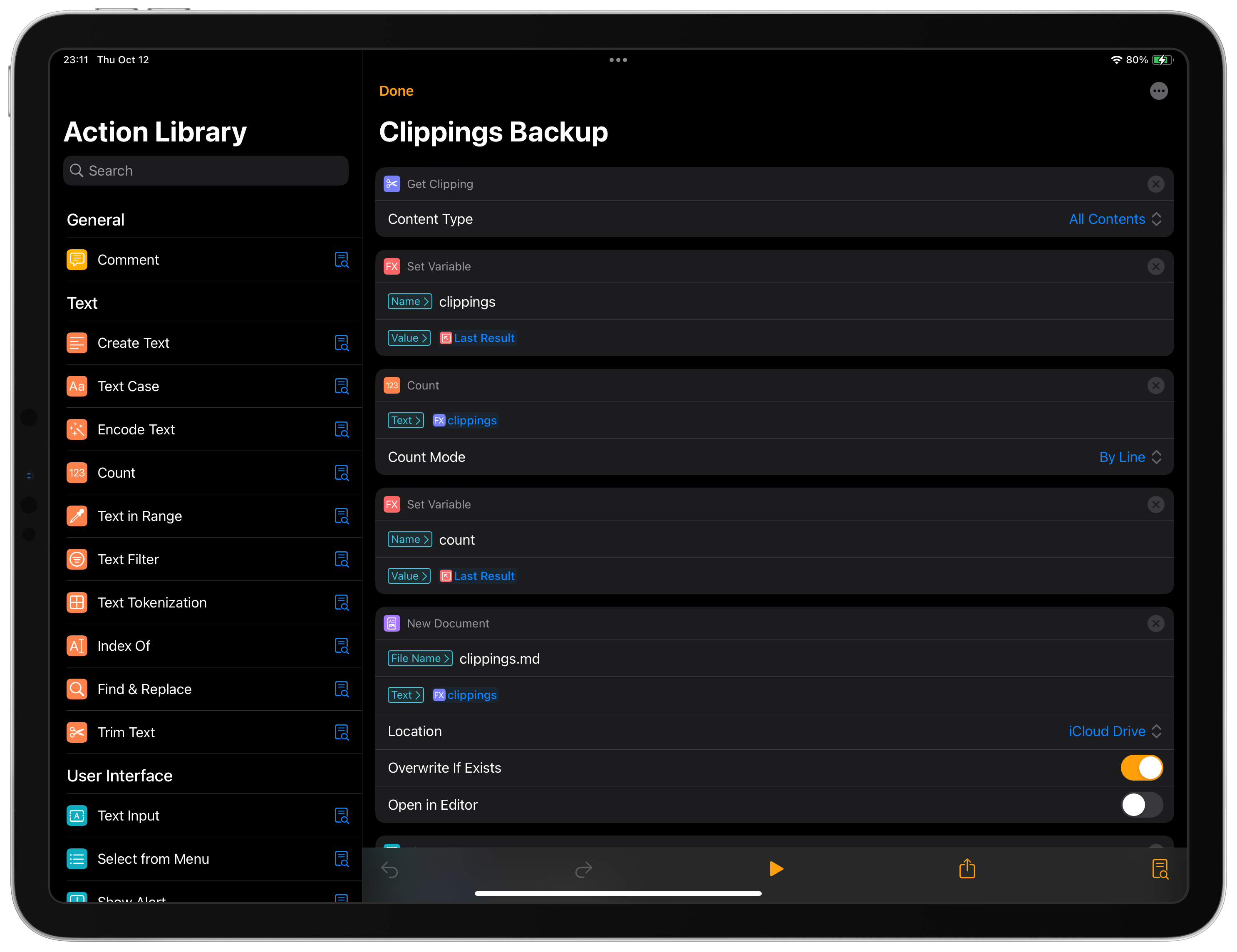
taio://actions?action=run&name=Clippings%20BackupThis action uses the Get Clippings action step to return the content of all clippings, which is then counted by lines and backed up (by default) in the root of one’s iCloud Drive storage for Taio as clippings.md. (iCloud Drive/Taio/Editor/clippings.md) Before finishing, the action displays the number of lines it has backed up.
{
	"actions": [
		{
			"type": "@clips.get-text",
			"parameters": {
				"mode": 1
			}
		},
		{
			"type": "@flow.set-variable",
			"parameters": {
				"value": {
					"value": "$",
					"tokens": [
						{
							"location": 0,
							"value": "@input"
						}
					]
				},
				"name": {
					"value": "clippings"
				}
			}
		},
		{
			"type": "@text.count",
			"parameters": {
				"mode": 0,
				"text": {
					"value": "$",
					"tokens": [
						{
							"location": 0,
							"value": "clippings"
						}
					]
				}
			}
		},
		{
			"type": "@flow.set-variable",
			"parameters": {
				"value": {
					"value": "$",
					"tokens": [
						{
							"location": 0,
							"value": "@input"
						}
					]
				},
				"name": {
					"value": "count"
				}
			}
		},
		{
			"type": "@editor.new",
			"parameters": {
				"location": 2,
				"openInEditor": false,
				"filename": {
					"value": "clippings.md"
				},
				"text": {
					"value": "$",
					"tokens": [
						{
							"location": 0,
							"value": "clippings"
						}
					]
				},
				"overwriteIfExists": true
			}
		},
		{
			"type": "@ui.toast",
			"parameters": {
				"style": 0,
				"waitUntilDone": false,
				"title": {
					"value": "$ Clippings Backed Up",
					"tokens": [
						{
							"location": 0,
							"value": "count"
						}
					]
				}
			}
		}
	],
	"buildVersion": 1,
	"name": "Clippings Backup",
	"clientMinVersion": 1,
	"summary": "Backs up all clippings content - merged in a single text file - at [iCloud Storage]/clippings.md.",
	"icon": {
		"glyph": "externaldrive.badge.checkmark",
		"color": "#10ADC0"
	},
	"clientVersion": 1222
}
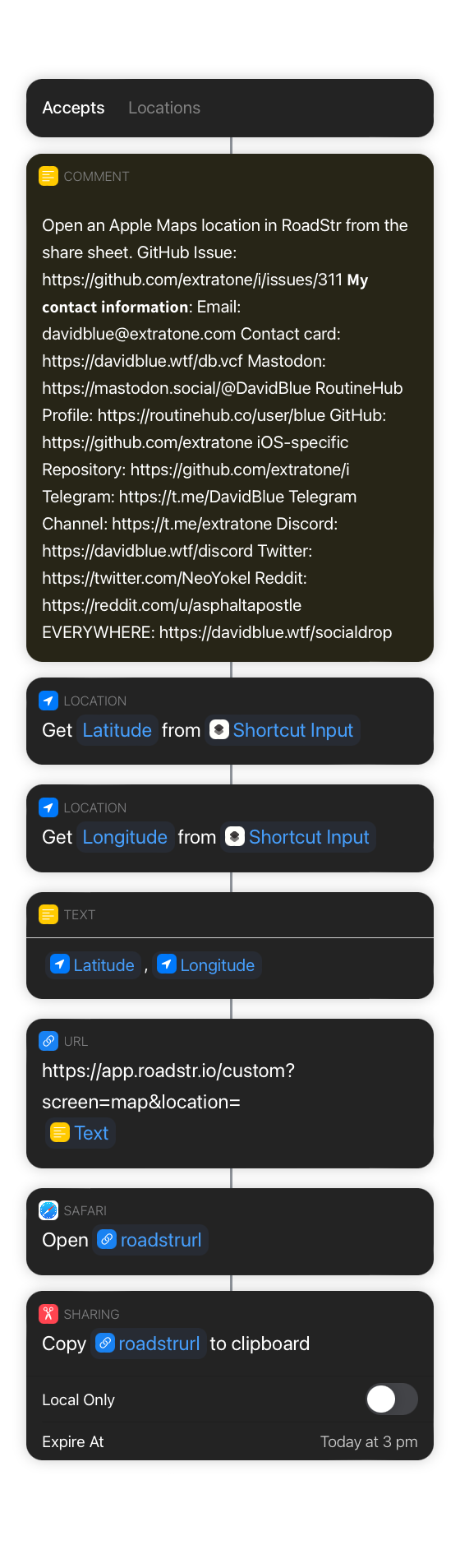
An extremely simple, but pointed Siri Shortcut for opening Apple Maps locations as waypoints in RoadStr’s map view, directly from the share sheet by constructing and then opening a URL in the following syntax:
https://app.roadstr.io/custom?screen=map&location={longitude,latitude}
What is the best way to dissuade a repeat offender from catcalling without involving law enforcement?
Addressing catcalling without involving law enforcement can be challenging but here are some non-legal approaches you can consider:
Remember, your safety is the top priority. If a situation feels unsafe or escalates, prioritize your well-being and consider seeking help from authorities or others nearby.
I was hoping to take action on behalf of my girlfriend, actually, who has been the actual target of said catcalling while walking downtown.
I understand your concern for your girlfriend’s well-being. Here are some ways you can support her and take action against catcalling:
Remember, your role as a supportive partner is essential, but always respect her wishes and decisions on how to address the situation. It’s essential to prioritize her safety and well-being in any action taken.
If I were to approach the catcaller myself in public without any hostile or threatening intent, how might I go about effectively making the argument that he should not be catcalling?
Approaching a catcaller can be a delicate situation, and it’s crucial to prioritize safety for both yourself and your girlfriend. If you decide to have a conversation with the catcaller, consider the following tips:
Remember that while addressing the catcaller directly can be empowering, it might not always lead to immediate change. People’s attitudes and behaviors can be deeply ingrained, so approaching the situation with empathy and understanding can be more effective than aggression or hostility. Ultimately, the goal is to promote respect and create a safer environment for everyone.
If I were to approach the catcaller myself in public without any hostile or threatening intent, how might I go about effectively making the argument that he should not be catcalling?
If you decide to approach the catcaller to address the issue of catcalling, here are some tips to effectively convey your message:
Remember, approaching a catcaller can be challenging, and not everyone may be receptive to your message. Your primary concern should be your safety and the safety of those around you. If the situation becomes uncomfortable or hostile, it’s essential to prioritize your well-being and consider seeking assistance from authorities or removing yourself from the situation.
If this proves ineffective and I do end up deciding to involve the authorities after all, how might I go about doing so with extra care to avoid putting the safety of the catcaller - who is an elderly black man - at any more risk than absolutely necessary?
If you find it necessary to involve the authorities due to persistent catcalling or harassment, it’s essential to handle the situation with care, especially when the person involved is an elderly individual from a vulnerable community. Here are some steps to take while prioritizing safety and sensitivity:
Remember, the goal is to address the issue of catcalling and harassment while prioritizing safety for everyone involved. Engaging with local community organizations or seeking guidance from resources that focus on these issues can provide valuable insights on handling the situation with empathy and respect.
This essay seeks to examine the breadth of donor-funded, open source, federated social networks as technical alternatives to commercial online environments like Facebook and Twitter as measured by their users’ overall satisfaction with them as means of social interactivity over time. Following recent debates and confusion regarding the ethics in the practices of the organizations which built them and the extent of their complicity in the radical cultural consequences of digital communication surrounding the United States’ Presidential Election in 2016, it proposes that greater rhetorical and legislative attention be invested in the tangible, documented design decisions across their products’ history as the most crucial, relevant, and effective means of understanding the whole context, within which it will define open source software development and federated networking in contrast to the guarded industry establishment which the dominant services have transitioned from disrupting by design to entirely exemplifying thus far in the century. After examining conspicuous alterations and inexplicably silent feature additions and subtractions across the whole of social network development, as well as their eventual result’s reflections on the conscious satisfaction of individual Social Media users, it will conclude by profiling a select few communities thriving on donation-funded, collaboratively maintained, and/or decentralized platforms as superior foundations upon which citizens of the web might rebuild their own traumatized and fragmented networks when they are ready to begin again.
If we accept Electronic Mail as the absolute genesis of what we call “Social Media,” the term becomes inextricably linked with the history of the World Wide Web as a whole. The technical protocol we know as Email is by nature “decentralized,” “distributed,” and “federated” as the terms are used in this essay because it is technically unbeholden to any single transmission or client service — commercial or not — and it allows users to participate with any server installation they choose, up to and including personal email servers installed in one’s home. In this essay, “decentralized social networks,” “distributed social platforms,” and “federated social networking” fall together under the category of “open web technologies,” which are by definition non-proprietary. This essay proceeds under the notable assumption that The Web as a whole “was, at its core and in its design, a democratizing technology,” and that its potential to be more “open” will remain limitless as long as its fundamental structure is at all recognizable as The Web. In fact, using the adjectives “decentralized” and “distributed” in front of any web-native technologies could be considered oxymoronic, as The Web’s existence as an entity comprised of many interconnecting interconnections without any requisite central spaces or governing bodies remains technically unmolested, despite the encroaching would-be for-profit adjudicators Google and Facebook. (While the abrupt and total disappearance of either or both company’s total online proprietorship would be a massive event, the remainder of The Web would continue to function.)
Email is undoubtedly a form of social networking, though it was the addition of Bulletin Board Systems (BBS) — a parallel technology — that manifested what many scholars have offered as the first published media for the sake of socializing online. Four key pillars of Social Media services in their current form were arrived upon within an editorial issue introduction for Telecommunications Policy:
In 1996, Poet, Grateful Dead ghostwriter, and co-founder of the Electronic Frontier Foundation John Perry Barlow published a manifesto entitled A Declaration of the Independence of Cyberspace which proves an insightful abstract into the most romanticized, principled, and abstractly ideological thought of that period surrounding The Web’s future.
Cyberspace consists of transactions, relationships, and thought itself, arrayed like a standing wave in the web of our communications. Ours is a world that is both everywhere and nowhere, but it is not where bodies live. We are creating a world that all may enter without privilege or prejudice accorded by race, economic power, military force, or station of birth. We are creating a world where anyone, anywhere may express his or her beliefs, no matter how singular, without fear of being coerced into silence or conformity.
From our retrospective, the bravado in Barlow’s declarations addressed specifically to “Governments of the Industrial World” presents an important contrast on which to reflect. Current events surrounding regulation of the tech industry reflect a general desire for more government intervention from both mainstream political parties in the United States. As I write, an appearance by the CEOs of Twitter and Facebook in front of a Senate Judiciary Committee has just concluded, during which both fielded questions from senators of both mainstream parties, largely regarding “censorship” on their platforms performed by the companies themselves. It is beyond the scope of this essay to address the particulars of this issue, so we are going to continue under the assumption that privately-owned social platforms have the constitutional right to censor, manipulate, or otherwise editorialize User-Generated Content (UGC) as they see fit, but it will outline specific advantages with regard to “The Censorship Issue” offered by current Federated Social platforms. The reality of Barlow’s fears in 2020: even if the United States government had intentions to regulate speech on The Web, it has consistently demonstrated an inability to comprehend the meaning of such action, much less an ability to enforce legislation within the realm of online speech.
This essay cites heavily from meta-media publications like the Columbia Journalism Review and Harvard’s Nieman Lab, as well as from several individual articles oriented around the subject of social media’s impact on the way news is consumed, skewing its bias toward the media industry in many ways. I pursued this direction in order to make what I believe to be an original suggestion: Federated Social Platforms are ideal solutions to this issue, too, largely because of their widespread omission of any non-linear (algorithmic) content prioritization in timelines. Much like Twitter’s original design, content on services like Mastodon and Diaspora appears in a purely-chronological “Timeline,” which — if still present — is now a highly-obscured option in mainstream proprietary networks. Inevitably, it discusses recent efforts by Facebook, Twitter, and other platforms (which I will occasionally refer to as “Big Social”) to reform aggregative processes within their functions as news-sharing services as it cites the research critics have referenced in response.
While user-maintained Bulletin Board Systems (BBSs) like Usenet and Fidonet established Open Web forums in the 1980s, a proprietary parallel called CompuServe migrated from its original implementation as a “business-oriented mainframe computer communication solution” to the public domain. As of Fall 1994, CompuServe charged $8.95 per month ($15.94, adjusted for inflation) for “unlimited use of its standard services,” which included “news, sports, weather, travel, reference libraries, stock quotes, games and limited electronic mail,” and between $4.80 and $22.80 per hour ($8.55 to $40.61, adjusted for inflation) for use of its “’extended’ services,” including a variety of discussion forums established by topic. In the 1990s, it would be joined by competing internet service providers Prodigy and America Online, the latter of which originated the first “member profiles” for users, forming the third pillar of Telecommunications Policy’s Social Media requisites.
Inheriting the environment pioneered by these original titans were the first college-oriented networking sites like Classmates.com, myYearbook.com, and SixDegrees.com. The former introduced the concept of user discovery by way of grassroots associations and has managed to survive (in some form) to this day. SixDegrees was notable as “one of the very first [Social Networks] to allow its users to create profiles, invite friends, organize groups, and surf other user profiles.” Following social development of the original services goliaths and these insular collegiate networks, another microcosm sprouted up within this first generation of ethnic-oriented networks such as AsianAvenue.com and BlackPlanet.com, which both continue operation to date.
The meat of the social media industry’s curve throughout its history up to this point is occupied by a string of networks — most forgotten — following the hallmark of Friendster’s launch in 2002. A year later, LinkedIn was launched as the “more sober,” business-oriented network offering. MySpace — “once the perennial favorite” also launched in 2003. Then, in 2004, TheFacebook.com launched within Harvard University as a means for students to “search for others in their courses, social organizations and Houses.” Almost immediately (just six days later,) the service’s extensive legal history began when three fellow Harvard students accused founder Mark Zuckerberg of “intentionally misleading them into believing he would help them build a social network called HarvardConnection.com.”
It is difficult to find an examination of Facebook’s commercial success from a critical perspective among technology media that has almost entirely embedded itself within the industry it claims to keep in cheque. The vast majority of technology press organizations are based in either Silicon Valley or New York City. The Digital Trends article I have just cited heavily from goes on to suggest that it’s a “universal agreement” that “Facebook promotes both honesty and openness,” when an examination of the discourse surrounding Facebook outside of technology culture suggests otherwise. Much of the related literature from academia surrounds the company’s perceived mishandling of “Big Data” and a broad discussion of “privacy” and its perceived new meaning.
Since the “Cambridge Analytica scandal,” legal attention toward Facebook has become popularized in conversation, so the dissemination of related details is beyond the scope of this essay.
Facebook, Inc. claims to have made a significant effort to become more transparent, especially since Mark Zuckerberg began appearing in front of special senate judiciary committee hearings in 2017. “Facebook Open Source” publishes regular content on opensource.facebook.com, including a podcast called The Diff. In its inaugural episode, entitled “Inside Facebook Open Source,” the intercompany title “Developer Advocate” is explained, along with an anecdote on the origins of Open Source within the company, begun by host Joel Marcey:
Many people know that Facebook was developed in a dorm room by Mark Zuckerberg on a stack of LAMPP: Linux, Apache, MySQL, PHP, so from the beginning Facebook has had Open Source in its culture.
When asked how Facebook determines when to open-source a project, guest and Developer Advocate Eric Nakagawa makes no mention of transparency, instead leaning entirely on the narrative of Facebook as an organization that seeks to improve the world:
One of the reasons we have for open-sourcing a project is it’s gonna make something better. It’s gonna improve either something in the industry — it might be a new, novel approach to solving a problem… Something that we built internally and want to share with the world.
Critics of Open Source development suggest that major companies like Facebook are often only interested in making projects public for the sake of “free labor” by outside contributors.
A documented history of Federated social networks is lacking, but a 2017 report by MIT’s Digital Currency Initiative entitled “Defending Internet Freedom Through Decentralization” offers the most comprehensive review I was able to find on the subject. Theirs begins with the invention of a hardware project by “open Internet activist” Eben Moglen in 2010 “with the aim of shifting away from large, corporate owned server farms to a more community-oriented model for managing communications online,” called Freedom Box, and its relationship with Diaspora, the first federated SNS. The Diaspora project was launched by a group of Moglen’s students at Columbia University, originally intended a “distributed social networking service that addressed consumer privacy concerns by enabling users to host their own content on a friendly community device, like Freedom Box.” This vision depended on Moglen’s heavy emphasis on self-hosted servers as the primary means for users to maintain their privacy, going forward.
In a WIRED article citing the study entitled “Decentralized Social Networks Sound Great. Too Bad They’ll Never Work,” Barabas suggests that “most people do not want to run their own web servers or social network nodes.” Diaspora exists today entirely separate of its original creators after its “young leaders” faltered under pressure from investor pressure to “’pivot’ the project to a more sustainable business model,” now in the hands of “the open source community.” As of November 2020, ~76000 total users were registered on Diaspora instances (called “nodes” by the community,) with approximately 17000 active in the past month.
Since 2017, the relationship between Mastodon and Twitter has exhibited a complete role reversal in key feature additions. While almost all of the articles and essays on the subject are keen to point out that Eugen Rochko modeled Tootsuite’s original UI after Tweetdeck (now an optional selection called “Advanced UI,”) the “mimicry” between the donor-funded, Open Source platform headed by a single German developer in his twenties and the 15-year-old for-profit social network maintained by a company with nearly 5000 employees shifts in the other direction upon close examination of specific featuresets. Just five months after Mastodon’s first penetration of the mainstream tech conversation in April of 2017 — with its default 500-character post limit and support for up to 5000 — Twitter announced its upcoming expansion from 140 to 280 characters. In October, 2017, with Mastodon’s second version release, support for image descriptions (alt text) for the sake of accessibility was introduced. While Twitter had long supported similar metadata in images, it did not do so on its main web interface (twitter.com,) Tweetdeck, nor its mobile apps until May 27th of this year.
Many Mastodon instance administrators and invested users had added feature requests on the platform’s GitHub repository for media posts to support audio playback intermittently throughout its development history, but Rochko initially resisted out of fears that allowing users to share audio files in posts would lead to Mastodon being “branded as a pirate music sharing service, and [their] project would end up getting blocked in search results.” Feedback would appear to have pressured him into giving in to this decision, as audio file uploads were quietly allowed in Version 2.9.1 of the platform, released on June 22, 2019.
Almost exactly one year later, Twitter first announced testing for “Voice Tweets” on June 17, 2020, which would not allow audio file upload but instead restrict users to recording within the Twitter mobile app in 140 second-long segments. A controversy ensued regarding Twitter’s omission of any efforts to transcribe Voice Tweets, further catalyzed by the subsequent discovery that the company did not have an internal team dedicated to accessibility.
It is still not known at the time of this writing whether or not Voice Tweets have been fully “rolled out” to all eligible Twitter clients, but Mastodon’s latest Version 3.2 release from August 2020 included an extensive rework of audio players in posts:
It will extract album art from the uploaded audio file automatically, or allow you to upload a thumbnail of your own choosing to be displayed in the center. Dominant colors from the artwork or thumbnail will then be used to give the player a unique look.
These features are hardly comparable except for their common disuse. Data regarding status type is no longer publicly accessible for either platform, but my personal experience as a heavy user of both suggests that audio posts are generally not a priority.
One of the most popular laments of Twitter users for virtually its entire history surrounds the inability to edit Tweets after they have been posted. When I interviewed Eugen Rochko in 2017, he explained the central issue with implementing such a capability from his perspective:
That won’t happen. There’s actually a good reason why they don’t do that. It’s for the very simple reason that you could make a Toot about one thing, have lots of people favorite share it, link it from other places, and then suddenly it says “heil Hitler,” or whatever.
Instead of live editing a specific status update, Mastodon’s Summer 2018 response to the issue — called “Delete & Re-Draft” — allows the user to edit the contents of a post in the compose interface immediately following its deletion, so that no information need be revised while live on the network. Rumors and bugs have contributed to an extensive mythos surrounding editable statuses in Twitter’s case, but CEO Jack Dorsey did explicitly address the possibility in a Q&A published by WIRED in January 2020, saying, simply, “we’ll probably never do it.”

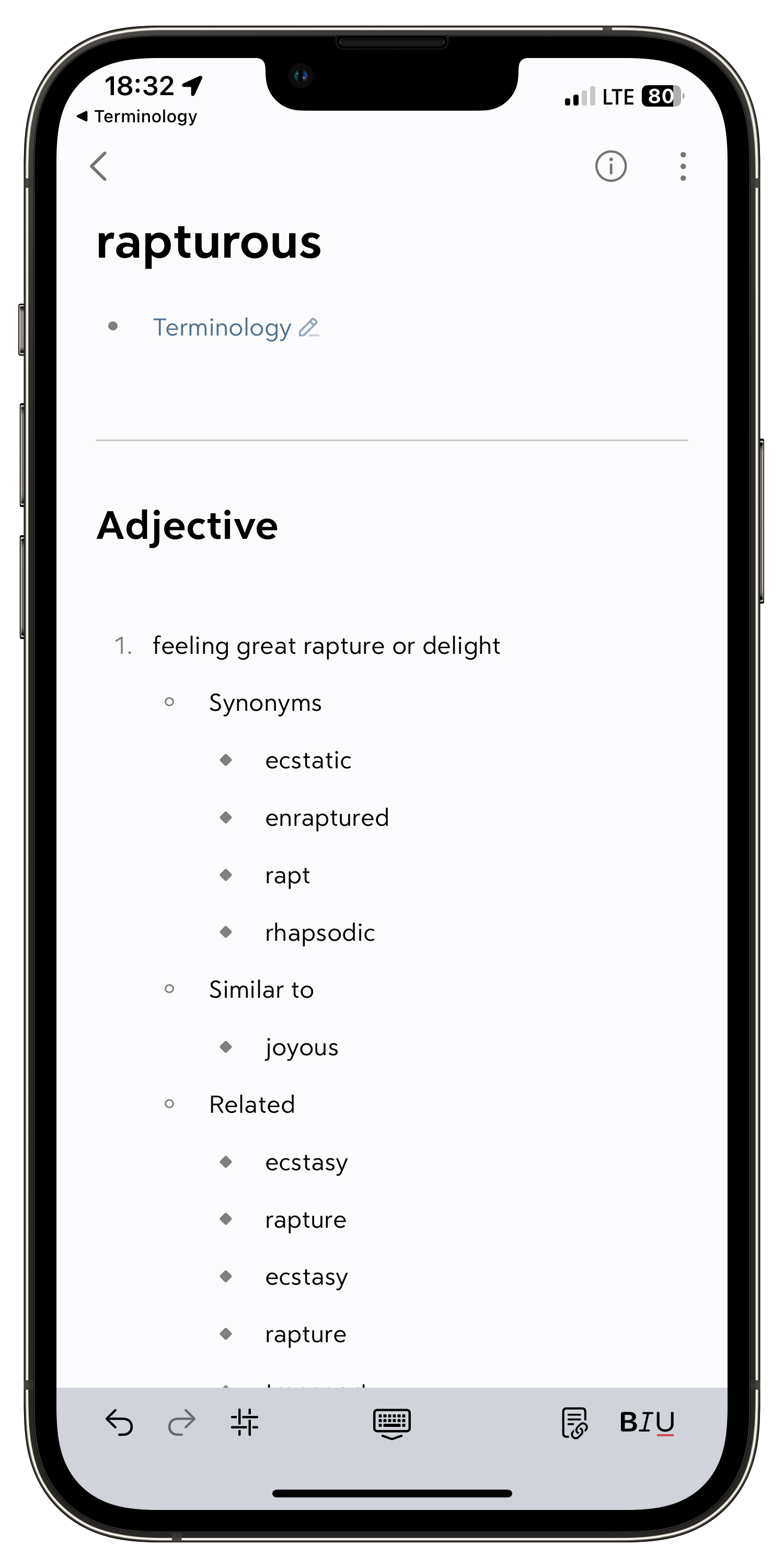
Depending on your purpose for a dictionary app, this is the best one on iOS. I use mine to both look up established words and store words I’ve “created.” A lot of the words I want to store come from @HaggardHawks on Twitter, and most of them are both 1.) actual words, often from history and 2.) not in any established dictionaries.
These do not show up in apps like LookUp, which will leave you plumb out of luck. Terminology, however, lets me store definitions/other information for “new” words via its “notes” function. To be honest, I can’t imagine moving through life and not creating my own words from time to time, but I understand we’re all different.
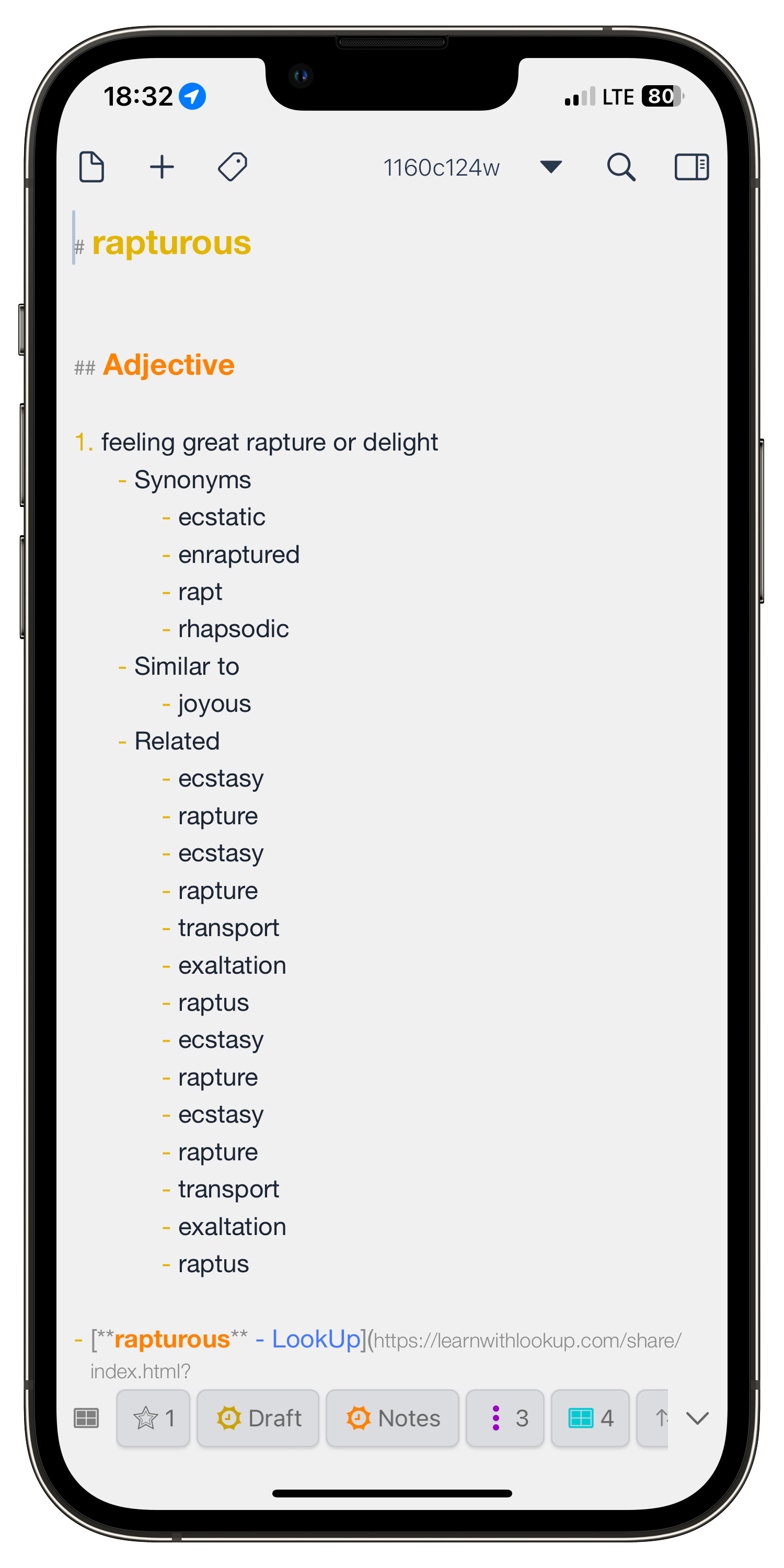
If you’re a Drafts user, I would consider Terminology an absolute must-have. It took me five minutes to establish actions on both apps which allow me to lookup selected words with a keyboard shortcut ^⇧D from the former instantly in the latter and - with a single tap - return definitions, synonyms, and antonyms to a new draft. It’s wonderful, absolutely indispensable, and fun!