
Needs a comma here.
Vril's 'Anima Mundi'
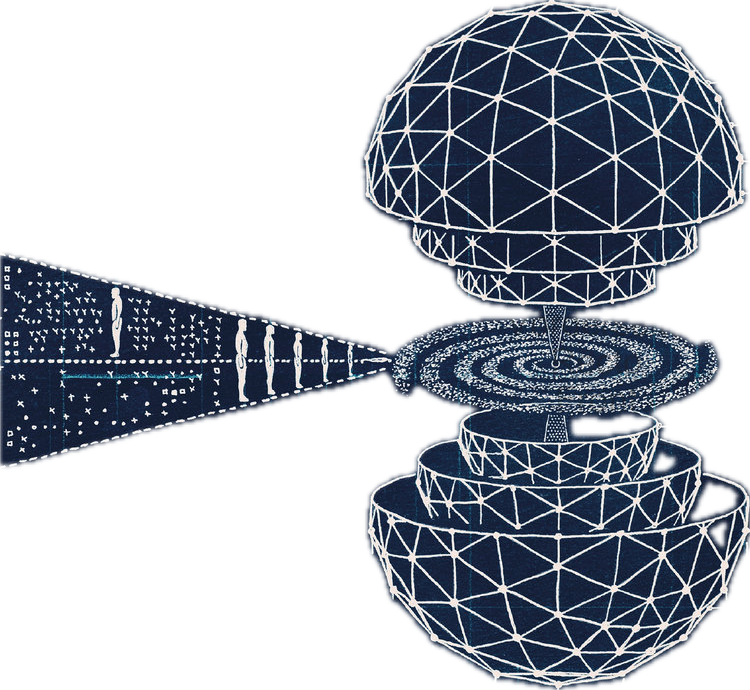
With Anima Mundi, Vril departs from his Berghain roots and delivers an introspective exploration of his eternal soul.
If I’m allowed to have favorites, I would claim Vril, the German DJ and Resident Advisor Lieutenant, as mine among his genre, which shouldn’t mean anything to the longtime techno connoisseur (who should probably find themselves skipping this review and moving on,) but does lend me to evangelize to those who’ve been deprived of positive exposure to the culture. Most any electronic music can be transportive and my own affection for it can no doubt be attributed at least in part to my near-total isolation from its community. I have never been to a proper club (the only offering in the setting of my young adulthood has never aspired beyond squishy DJs who are now somehow 100% content describing their scene as “EDM,") and I’ve only had a few friends with whom I could share significant interest, though their knowledge was extraordinarily extensive. It takes incisive wisdom to cut through “Techno” as the misnomer it has become in today’s America - a subject deserving its own, more deliberate discussion - but for the moment, let’s consider a single record which manages to exemplify the potential of this historically-niche medium.
For years, I’ve been one hundred percent sure that “Vril” is a proper noun, but I could very well have gone on living the rest of my life never deciding between whom or where. Up until Anima Mundi’s release on October 15th (technically it was released last year, but exclusively on cassette,) his catalog was consistently Vril - on-brand, you might say - though in the most respectable sense for a dance DJ, I’d imagine. I can’t quite recall the moment of discovery, but I do know that the dozen or so of his live mixes available on Mixcloud caught my attention immediately afterward. There’s something magic in the layers that grabs an unnamed rhythmic organ of mine in a way that cannot be expressed in written form without experience I do not have. What I can provide is the most comprehensively concise example I can find: a live set from the infamous Berghain in 2014.
Regardless if I’m writing, walking(?,) or chasing gravel apexes, these mixes always kick me into another plane, where the panning high hat halos are biased astray by a fraction of a degree, delaying a false local disorientation akin to the sound of a dozen choreographed kindergarten tap dancers' feet next to one’s head, mildly duration-compressed. Techno as a whole has become quite comfortable with the practice of orbiting high frequency percussion in elongated ellipses around the stereo picture, which I’ve adored and defended since day 1. My hypotheses: it’s actually a cheap shot for the psyche’s potential desire for justification of their club experience as something transcendent. It’s a pretty easy cheat to keep the listener’s immediate environment feeling expansive, reflective, and therefore meaningful. I, myself am probably drawn to its threatening aura of imminent contiguous industrial emergency, but again, I’ve never been to Berghain, London, or Stockholm, nor has my adult nightime recreation ever found me in any venue to which one could attribute the term “club” without immediately ``chuckling. This music has not traditionally found its place among lives like mine, and nobody even seems interested in figuring out why.
It seems like there was a big thirst for these kinds of intentions. But the more attention we get, the harder it gets to keep those intentions up and not get washed away by the perception of others. Who are maybe searching for something that sometimes seems impossible to deliver.
For the hell of it, let’s begin by removing one of techno’s most notoriously-defining categorical descriptors: “dance music.” I’ve done this personally - aside from moderate head-bobbing - but I’ve already got a bad habit of miscontextuallizing music, so let’s focus on our hypothetical technovirgin, Gavin, who thought Bassnecter was amazing in 8th grade, can “sometimes fuck with” run-of-the-mill dubstep, plays college football, and is generally more serious about schoolwork than the trashy campus bars he visits every other weekend out of a vague desire for female attention. Let’s have faith in Gavin and assume that he doesn’t need perspective-altering narcotics to be introspective, but we’ll wait until he’s alone in his shitty dorm in the early morning hours, typing out an American History essay on his MacBook. He’s in his bed, earbud-equipped noggin propped uncomfortably against the wall, machine resting on his diaphragm. It’s streaming fucking Aphex Twin from some stranger’s Spotify playlist, which we’ve hacked. Just after “Windowlicker"’s last, foul moan, we’ll covertly begin this involuntary acquaintance with “Manium"’s simple fade-in.
It’s sincerely serious, contemplative, science fiction-esque, but certainly not even as manic as the tasteless breast-obsessed number one hit he’s just heard. In fact, the contrast is so sharp that his attention is agitated away from his sentence, and he looks off the screen across the room to the door’s electronic knob. According to whomever wrote Delsin’s description of the album, Gavin has just unwittingly set upon “a deep excursion for mind and body” - a phrase which would no doubt make him a bit uncomfortable, yet here, alone, or perhaps in the back seat of the right friend’s car on a long drive, its acute caution compels his mind to consider the heaviest possible question of the moment: something about finals, I would guess. His brow slowly scrunches in the Word document’s soft white glow. The unchanging dissonance from the background synth’s single chord grows louder and louder, gradually, before dropping briskly, allowing for the similar successive fade-in of “Statera Rerum.”
Layer number one is surely a four-second sample of a dot matrix printer’s operation, slowed and pitched-down thirty or so percent - reminiscent of the phenomena to which shopping cart castors are commonly subject: a certain speed’s vibration triggers a sort of resonant buzzing freakout. Vril’s simplistic construction continues with another mechanical layer, then panned pulsar synths which ebb and recede in lazier loops across the spectrum. By now, Gavin is on his way back to reality and has finally begun alt-tabbing by the last few seconds of track 2. Just as he finds and restores his Spotify window, it has ended, and the album’s title track begins. His investigation is stymied for a beat by the identical track and album metadata, but he’s still curious enough to search the album out after figuring it out. Since this is a hypothetical world, let’s make it just a bit better and assume Anima Mundi’s Bandcamp page is the first result returned by Gavin’s search engine with its brief, but gorgeous motion graphic promo video, which he allows to play parallel with track 3 on Spotify since it’s less than 30 seconds.
The resulting cacophony is unlike anything he has ever heard, and - probably in reaction to his essay topic’s inability to stimulate him whatsoever - its somewhat extended battle cry elicits sufficient intrigue to keep his attention from straying further. It’s a lucky thing, too, because the rework of “Riese” (literally “giant") is up next, and it’s the most profound and unexpected groove on the whole record. It’s rhythmless, reflective, and very cinematic in a similar (but far far superior) doctrine to Hans Zimmer’s use of simplistic, swelling harmonious chords to blast audiences' emotional intelligence to smithereens behind films like Michael Bay’s Pearl Harbor and J.J. Abrams' Star Trek. According to Inverted Audio’s review, its notes “lose their dissociative feeling for something a bit more intimate and in turn gain even more emotional power over the listener.” Essentially, it’s real gorgeous, though Gavin’s not quite in a vulnerable enough state to be moved to tears. So far, Anima Mundi has been almost entirely separate from “techno” as it is commonly defined, but it’s clear to even the most casual fan of the scene that it’s definitely an addendum, not abandonment. I could be wrong, but as a fan of Vril’s, I’ve found the four tracks Gavin’s heard up to this point feel almost like the endnotes to the more brisk, purposeful melodic and rhythmic identities formed in Portal, his first album, along his years of live club arrangements. If I were to be a bit bold, I’d surmise that Vril could consider Anima Muni an artistic declaration: just so you know, I am a lot more than just the guy behind the booth - I am a “world soul."
I’m afraid it would be dishonest of me to extract a happy ending from my derriere for this hypothetical of ours because of a single word in track 5’s title with truly awesome power among the Youth of Today: anime. In Spring 2017, I recorded Futureland’s most entertaining episode with my good friend Tevin, who happens to be a beautiful bridge between fraternity culture and Japanese Animated Video Content, yet lacks faith in the former’s chances of progressing much at all, going forward. Gavin has probably been exposed to anime once or twice, but for him, it’s unlikely to ever become anything but a punchline. “Infinitum Eternis Anime” means (roughly) “infinite eternal soul,” and it’s the record’s first amalgam of recognizably techno elements (for which I do not know any of the industry/jargon terms, so do forgive my lack of detail.) It’s a shame Gavin won’t give it a chance because it’d likely serve as an effective gateway drug for a more sophisticated nightlife, but I’m sure you were getting awfully tired of him, anyway. To cite Inverted Audio’s Will Long once more:
Each one of the tracks from the ‘Haus’ EP works even better in the context of the full record. “Haus” gets an even smoother, more melodic rework; “Riese” is also more melodic in construction with the beat stripped away in favour of more reverb and sustained notes. They lose their dissociative feeling for something a bit more intimate and in turn gain even more emotional power over the listener.
Though his comparison of Anima Mundi to Kubrick’s 2001: A Space Odyssey was quite crude, I can obviously concur with some of his other language, like “future classic,” and “buy on sight.” As much as I’d like to further indulge my own analysis of the rest of the 80 minute work’s tracks, one-by-one, let me just conclude by doting on my personal favorite track, “Sine Fine.” Without resorting to the word “ambiance,” I can’t say much, but - above all - it’s Track 10 that takes me to The Vril Place in which I have always felt so intrigued and comfortable. Buy Anima Mundi right fucking now.
It's Transfiguration Time

It’s Transfiguration Time
Extratone will be refocusing as a dedicated electronic music magazine with print issues on hand before 2018 is out.
It’s been far too long since I last came to you with compelling news truly worthy of anticipation, but I’m relieved to do so today in a somewhat-epiphanous certainty that the past two and a half years of my very meticulously-documented struggle to give this project a clear direction will soon feel well worth the experience for all involved.
This week, we’re inaugurating our new top-shelf Music section with a comprehensive tour throughout the history of the streaming platforms who’ve both nurtured and ripped off the voices from an entirely new generation of artists followed by an album review which will be sure to blindside you in your kidneys with a fundamental truth I know you’ll love, (but could never guess.) Don’t think we’re crying wolf (or is it “passing go?”) this go-around: /music is going to become the singular subject of our attention for the foreseeable future.
We’re going to take Extratone full circle and make an Electronic Music magazine for the new underground (who are more logged on than they are subterranean.) The online community of friends who’s talents have continued to compel me to figure this thing out have only become more and more extraordinary in their crafts, pushing the whole network further and further upward toward its inevitable penetration of the churning, relentless surface discourse in what has become an awkwardly treacherous Indie Ocean. While a few flagships of the American underground techno magazine like Trax have managed to remain afloat, they’ve been worn down into complacency by the mellowing of their scene and unavoidably shifting priorities after the years they’ve got on us. It’s been alarmingly apparent since 2012 that music journalism would be totally unequipped to spot the heroes of the genre and DAW busting Twitter gang in the crucial moment.
For this moment, suffice it to say, the destiny of our music is at hand, and I’ve happened to acquire just about got all we need to build a big fucking boat.
Here’s what the rest of 2018 is going to look like.
For the next two months, I’ll be combing through the entire King James’-worth of stories we’ve published since launch and meticulously arranging the best of them in a hefty, visually-unbelievable sort of print anthology, which you’ll soon be able to preorder. This issue will represent the whole of my being’s effort for like… half my 20s (if you’re rounding up,) and I know getting my hands on the first proof is gonna make me cry like a toddler, so you can be damned sure it’s going to be something very special and you’d better feel damned guilty if you pass it up.
However, it’s also not something I intend to do on my own. I will undoubtedly be paying for art, illustration, and help with print design, so do please email me with your favorite pitch for magazine art and/or that secret masterpiece of an InDesign template you’ve been sitting on. (Cover art is way more difficult than I expected. Please help me.) Don’t be afraid to join in the novelty of seeing a message (or dumb anime reference) of your own in print — I plan to pepper the issue with little messages, so stop by our Discord and chat me up.
In the meantime, you can help tremendously by forgoing just one soda every four weeks for a hardcore cause to subscribe for $1 via Patreon. As of today, our new support goal is to raise $30 to pass immediately along for a single freelance album review per month.
By winter, we’ll be set to hose down the server in digital baptism so that we may start anew on the future from the best possible foothold when 2019 rolls around. I’ll be in touch with regular updates and more specific calls for freelance art very soon.
Update: I was much too hasty in this proclamation.
Update: I was much too hasty in this proclamation.
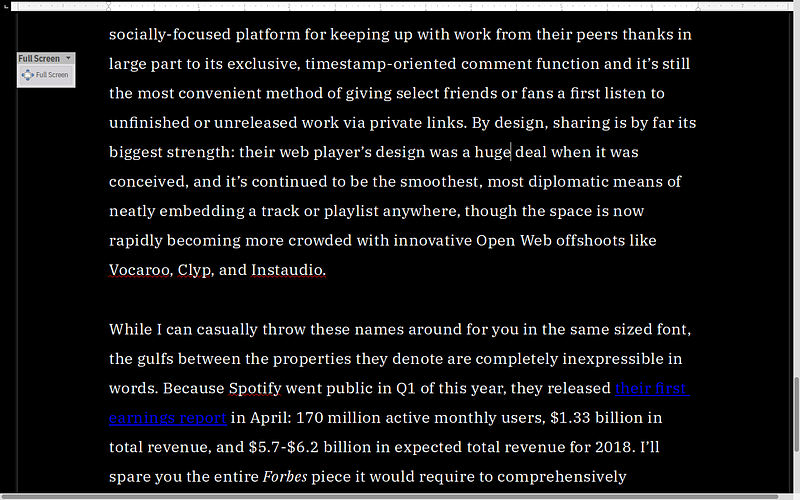
Having now pounded through a few thousand words with LibreOffice Writer running on Linux Mint 19, I must now follow up soon in one form or another. This isn’t a “night mode” function by name, but it may as well be: it takes just 30 seconds to search out and change color settings across the whole application.
What has Bandcamp Done for You as an Artist?
When did you first begin using Bandcamp as an artist?
How has Bandcamp performed for you as an artist differently from other online music distribution services like SoundCloud or Last.fm?
What do you like best about Bandcamp as a platform for music distribution?
How do you think Bandcamp could improve on its artist publishing tools?
How could Bandcamp improve editorially to best curate and distribute YOUR work?
Percy Hole, Editor at The Sun, Dies Pursuing Rock Springs Story
Percy Hole, Editor at The Sun, Dies Pursuing Rock Springs Story

Percy Hole, who in his seven years at The Sun contributed in no small part to its resolute commitment to the Superior community throughout a key period of change and transition, died nobly on Wednesday in Rock Springs while pursuing a story fraught with sensitive historical currents to which he had committed himself for the better part of the past year. He was 29.
Stuart Stud, the Editor-in-Chief of The Sun, announced the death to the staff Thursday morning. Mr. Hole, who had moved to Superior after being scouted by the paper upon receiving his bachelor’s degree in fly fishing from New York University, succumbed to a catastrophic failure of his liver after allegedly “consuming a far greater-than-recreational quantity” of alcohol during an informal interview with an auxiliary source, according to someone familiar with the matter within the Sweetwater County Coroner’s Office.
In title, Mr. Hole climbed quickly from Sports Editor to Executive Daily Editor, but colleagues cited several integral, unpaid roles beyond his official functions in the newsroom.
“He was a real winner,” said Hilary Hutch, who Hole had groomed personally to replace him as Sports Editor, “by far the sexist human being to grace this pokey office. An impossible talent. We were so lucky to be work alongside him for so long. There was no better wordsmith in the whole industry. He definitely deserved a huge raise. A true legend.”
His responsibilities as Executive Daily Editor included arranging the entirety of The Sun’s print edition singlehandedly every morning, answering every staffer question with heroic brevity, captaining the paper’s infallible ethical prestige, editing all copy with an eye matched by not a one of his contemporaries, lifting and carrying all materials and equipment over 150 lbs. along with the entirety of the office’s championship-winning, regionally competitive basketball team as point guard.
“I’ve never seen anyone move like that,” said Ms. Hutch of her experiences playing on the team, “it was like he was some kind of super-evolved proto-human. We were really just baggage, mostly — decoration — but he was generous and humble about it. He never hogged the glory even though he almost always had every right to.”
Mr. Hole’s colleagues also described his stellar performance and natural talent as generally unappreciated in bolstering The Sun’s late entrance into digital publishing and web 2.0.
“Pivot to video,” said Mr. Stud.
'Mom and Dad''s Discrepant Defense Against Stale Industry and the Population Problem
‘Mom and Dad’’s Discrepant Defense Against Stale Industry and the Population Problem
A “fun” movie.
 The Earth will reach its maximum occupancy load (12 billion) when I am in my mid-fifities, meaning there’ll be more than twice as many gorging, shitting, shooting, complaining, and lying human beings than there were when I started, and perhaps Brian Taylor’s Mom and Dad is in fact a reasoned argument for a particular solution to our inevitable plight. I’m still not sure what a “cult” movie is, precisely, but I can’t imagine what sort of cult could possibly sustain itself around the ethos of this film alone, despite its concise, agitating, at once lighthearted, yet genuinely-disturbing trip. No, it is probably not propaganda. From the experts, you’ll get precisely the same review, varying only in length. The New York Times’ Glenn Kenny couldn’t be bothered with more than 250 words, but RogerEbert dot com’s Simon Abrams shelled out a whole 1000. They are suspiciously close to these big round numbers — perhaps each was written to respective quotas, and perhaps you could say all that could reasonably be said in 10, but I don’t care.
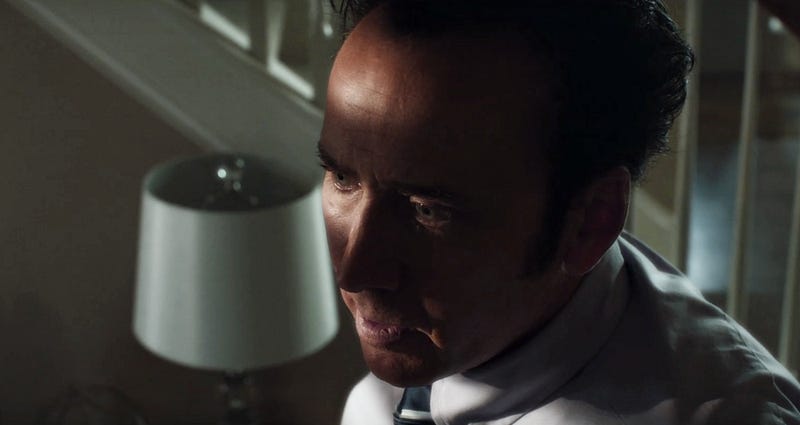
The tropes here are polished to a miraculous sheen — two emotionally-stunted, middleaged, overly preoccupied-with-their-lost-youth suburban parents (Nicolas Cage and Selma Blair) who’s existing envies & irritations regarding their own classically bratty teenage girl (Anne Winters) and her mischievous little brother (Zackary Arthur) is merely agitated by a sudden TV static-bound killer instinct into bloodlust, not originated. I’m not sure any pill dealer would actually flip off their customers after a fair buy — even in high school, but drugs, a black boyfriend, and a stinkbomb? in the old Trans Am!? I’m going to kill you!
Somebody, somewhere knew all the best sources on suburbia and how to put them to good use. The Camry, the golf bag, ping pong smashing, sweat-stained Big Sur tee, and Dr. Oz, for Christ’s sake! Granted, talking to your girlfriend/boyfriend on the phone at all is a bit dated — especially while riding a BMX — and I don’t think Froot Loops are generally accepted middle-class chow anymore. These are staples from my youth, and I am very old. Technically, the iMessage bubble graphics are more chronographically appropriate, but with great consequence, I fear — if we’re going to accept them once and for all as authentic mechanisms for telling stories set in the present, they are going to age faster than Nick’s new jowls (unless we’re all soon killed by our parents.) It’s been two years since I knew anything about music, but I seriously doubt even the gothest fifteen?-year-old girls are listening to Father-esque post-Memphis horrorcore in class — there’s something about SoundCloud that really clashes with chokers.
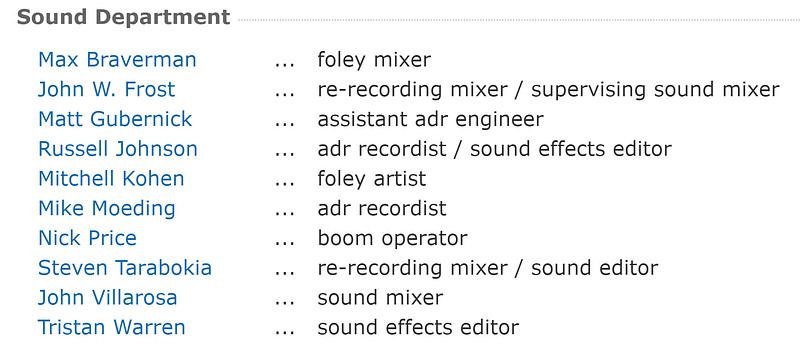
If there was ever a film in which to use grimy dubstep-influenced electronic slaps, buzzes, chirps, and great grating clanking, it’s this one. It’s a terrific disappointment that Hollywood feels so timidly about their use of the most intimate medium. One forgets its potential to control the nuances of an audience’s fear, anger, discomfort, and panic beyond cheap jump scares until they experience an irritating, distressing, ghastly gross, all-possessing feat of accentuating audio production such as that of Mom and Dad. If you want to judge Academically the effectiveness of a nominee’s work for an award with a title like Best Sound Editing (as opposed to whatever the hell criteria was met most fully by Skyfall,) you must give the little golden man to these folks, whoever they are.
When’s the last time you saw a truly, believably shitty modern parental pair on a big screen? I really can’t remember, myself. Brent and Kendall Ryan are masterpieces of character craft — both a perfect précis and thoroughly-defined exploration of miserable white suburbanites. They’re even named unimprovably, which reflects a quality in care and attention to detail that I very much appreciate. They are vain, vulgar, impatient, selfishly afraid, and careless, freely feeling and saying it all directly in front of their children. I love being told explicitly which characters to hate (no joke,) and in this case it’s the whole damned lot. Brian Taylor and Nicolas Cage scream it over and over (as I’d like to imagine) a single afternoon of one-take filming, considering that the latter took it upon himself to first memorize the entire screenplay and its prose, vanilla to perfection, before photography began, and I hope it all stays with him forever, especially “my mom is such a penis.”
Mom and Dad could conceivably be Nicolas Cage’s I Am Legend if for no other reason than the total lack of possible stand-ins for Brent Ryan — even the standard by which all white suburban Dad performances have been measured in the 21st century, Jason Bateman. Nick himself described it as “punk rock, rebellious, irreverent, original, badass,” and the “number one” movie he’s made in the past ten years (disqualifying National Treasure, in case you were worried.) No surprise, I must agree — this one is a wonderfully raucous and feral thing, but the scene involving the attempted murder of a newborn by her mother (Kendall’s sister) came very close to crossing the line. However, I am old and the intensity of my paternal instincts has probably outpaced my understanding of them. You could also argue, of course, that pushing such boundaries is a core function of a film like Mom and Dad. Nobody ended up vomiting or anything.
This fun thing shouldn’t feel as foreign as it does in cinema, but you already knew that. With all its implicit grapples with overpopulation, kids and gun violence, class, and racism — truly, this is a film charged electrically with current issues. Or maybe not. Ultimately, I can at least tell you for certain that Brian Taylor made exponentially better use of his resources (I couldn’t find a solid number for its production budget) than the Fucking Spierig Brothers did with Winchester (just so you know what a disaster looks like,) and managed to be refreshingly original (astonishing that nobody’s had this specific idea before.) A spectacular riot, Mom and Dad does all you could possibly want it to do. With just eighty-three minutes to lose, it’s worth the commitment just to hear Nicolas Cage whimper and say “anal beads.”
Give Voice to Hunger
The world today is a wealth of topics and perspectives, but daily biological functions are universal.
Everybody gets hungry, and we are in the everybody business!
Carter Wilkerson has been hungry for some time now, according to someone familiar with the matter. Yesterday, in agony, he resolved within himself to cease the toleration of his famine, and bravely typed a message on Twitter to Wendy’s — a national chain of restaurants where people often eat — pleading for justice. He wanted to know just how many supporters would have to stand up for his wellbeing before the company would do the right thing, and provide him his deserved nuggets.
As the whole world watched, they replied: 18 million retweets, and Carter will be able to eat.
Helping Carter is very easy: just retweet!
You won’t just be helping him, either. You’ll be letting all of your followers know — along with anyone stopping by your profile — that you like it when people eat, and that you like to eat, too! That passerby might just be looking for someone who also likes to eat and decide to follow you! Bonus!
The previous retweet record is about three million, so it’s going to take a lot of supportive allies, but hey — what’s more important than eating!?
I love eating and food more than anything else in the world, and that sentiment — as well as sharing it with others — is an essential component of my identity. I’m so lucky that my lifetime is spanning the greatest renaissance in the history of human communication.
Without intellectually and culturally enriching technologies like Twitter, how would Carter tell the world that he is hungry?!
How would I?
Thanks in large part to our generation, the exchange of ideas is more democratized than ever, and Twitter has played a huge role in establishing today’s current social media palette. If the speculation as to the likelihood of its demise has any basis in reality, perhaps it’s time for us to begin securing its legacy.
I don’t know about you, but I want to be remembered for my food memes, not my stance on whatever current affairs garbage happened to be bouncing around.
Regimes, ideologies, public figures, corporate entities, and human lives come and go, but I will always have to eat!
I mean, come on.
I don’t give a shit about Syria; I’m hungry!

And you don’t want to talk to me when I’m hungry! I lose all self-awareness and abandon any control of my person!
My friends (the ones who like to eat) and I have been using a new word we made up to describe this primal, pitiful state of being: hangry. Hungry and angry!
The best jokes are always the ones involving the consumption of food and its tremendous power over my life.
Hangry me? Unprincipled. Rabid.
A thief? Possibly.
A liar? Probably.
An abuser? Who knows?!
Food is everything to me, and meals are the milemarkers of my life.
What am I doing after I finish this piece?
I’m going to eat.
What would I do if you walked in the room at this moment with a delicious, gooey chocolate cupcake?
Abandon the job, of course!
And give you everything.
Good email.
Good email.
For God's Sake, Just Sit Down to Piss
-
Outline * Preface * Not necessarily directed at young men of color. (Or definitely not directed at them, but at white, CIS, straight young men.) * Describing the “real” scope of my authority. * While I have not traveled outside of America whatsoever, I have traveled within it fairly extensively. * My authority is especially strong when it comes to protestant Christianity. * Function of the book. * Chapter 1: “I Don’t Care What You/They Think”
"Apathy's Misconceptions"
“Apathy Misconceived”
		* <b>You do not <i>actually</i> want to attain a state of true apathy</b>, trust me.
		* Chris Cuomo exists.
		* Z-Ro
		* Apathy is even argued for in the Christian Bible. (The opinion of other people does not matter, only God's.)
			* <a href="https://blog.bible/bible-blog/entry/3-bible-verses-for-when-you-feel-judged-by-others">3 Bible Verses for When You Feel Judged By Others</a> | <i>Bible Blog</i>

			  Galatians 1:10: "Am I now trying to win the approval of human beings, or of God? Or am I trying to please people? If I were still trying to please people, I would not be a servant of Christ."


	* Chapter 2: "Music Taste Through Generations"

	  "Boomers' Destructive Generational Tastemaking Disaster"


		* Quote From <a href="https://bilge.world/bandcamp-streaming-music">the Bandcamp Essay</a>
			* It's bewildering how content we are to abruptly abandon the substance music had to our teenage selves out of misconstrued justifications for our classic fainéance – actively choosing to subject our public ambiance to thousands of replays of “the best” records in favor of dipping even the most cowardly toe into unfamiliar waters, even when the opportunity cost is inherently halved – only to then have the audacity to evangelize our dilapidated conceptions of “good music” to our children as we demonize the music of their generation, depriving them of a very essential rite of their cognitive development.<b><u> I can think of little more reductive, repugnant, reckless, or racist crusades as a model figure than indoctrinating your child with an inherent distaste for their own culture</u></b>, and nothing more deeply alarming to hear from the mouth of someone born in the 21st century than shit like “Queen was better than any rapper will ever be,” or “real musicianship will die forever with Eric Clapton.” It’s unfair and unnatural: imagine if your high school classmates had consistently turned up their scrunched nose at the living whole of rock & roll, declaring Scott Joplin to be the last musician they could stand.
			* Consider if the industry-wide customer experience standard for the musical ambiance in 1970s American eating and drinking establishments was entirely comprised of works by John Phillip Souza, and the most prevalent cultural revolution manifested itself something like the following: In countless popular films set in the time (and the stories told today by your parents of their youths that informs them,) a group of popular high school boys – generally three longtime childhood friends and a single addition from the previous summer with an Army Dad and a moderate bad boy aura that’s made him one of the school’s notoriously attractive students and the somewhat-abusive leader in the pack. After spending some time trying to convince the other three (the crucial moment for his case being the bad kid’s rare moment of sincerity trope) of its guaranteed social, sexual and financial ROI, they seal their agreement to start a band with a four-way saliva slap. Imagine if in the progression of this exhausted old tale, it remained entirely classic (and boring) when it faded to a “THREE MONTHS LATER...” ceiling shot of the four the in full, gleaming, performance-spec get-up of the presidential marching band in their garage, and it was revealed that they’d they practiced “The Star Spangled Banner” every night just to make the girls swoon in the film’s resolution with an encore of “America the Beautiful” at an unsanctioned (and very patriotic!) house party. Would you have made out on your first date with someone in your 80s high school Chemistry class after they’d was about but suffice it to say that it’s absolutely fucking bonkers how often I encounter “Sweet Home Alabama” (and other tunes I’ve already heard hundreds of times throughout the first third of my existence, conservatively) dripping down from the overhead speakers in all manner of big retail stores, where it’s inappropriate and unwelcome. Even from the generous assumption that every single one of them is an objective masterwork of composition, the amount of affection the American music listening audience has for the same 500 singles is on par with our rampant gun violence in terms of our unanimous tolerance for ridiculously illogical habits. I’ve been sitting in a cute, moderately trendy coffee shop on the corner of the major avenue of access to my cute, moderately trendy Portland neighborhood for an hour now, and I’ve recognized every single one of the tracks played just a bit too loudly on the stereo. I’ve been sick of them all since Middle School. That one Bow Bow Chicka Chicka thing… How very charming. <i>“The 70s, the 80s… the one-hit wonder channel!”</i>
			* Contrary to the popular hipster narrative we’ve just defeated, it’s not the popularity of the lineup that makes these experiences so distasteful, but their <b><i>regularity</i></b>. It doesn’t take a doctor of psychology to observe that tireless exposure to any given work of art inevitably erodes its value, yet we continue to expend resources saturating most mundane spaces in our society with an unyielding regurgitation of the same brackish pop culture symbols as if we’re trying to either induce a canonical vomit, intentionally obliterate the Yelp! reviews for a distant future museum’s “North America Enters the 21st Century” exhibit, or <i>both</i>.
		* This issue is not unique to American society nor to men, really, but is entirely the sickness of white boomers and gen Xers. It is an anomaly that has genuinely and profoundly perturbed me for virtually the entirety of my existence as a culturally literate entity - certainly longer than any of the other disturbances addressed in this volume.
		* The process of jazz becoming mainstream (which I think it had definitely by the 1940s.)
		* "<a href="https://medium.com/extratone/boomers-tastemaking-disaster-bb66330d2f29">Boomers' Destructive Generational Tastemaking Disaster</a>"
	* Catcalling
	* Clothes
	* Stuff we should <b>keep to ourselves</b>
* Credits
	* "I'm laughing at you and the best part is you won't truly understand why, in any deep and meaningful way, for another 20 years." - <a href="https://mastodon.online/@JustSomeGuy/104689299479520224">JustSomeGuy on Mastodon</a>